
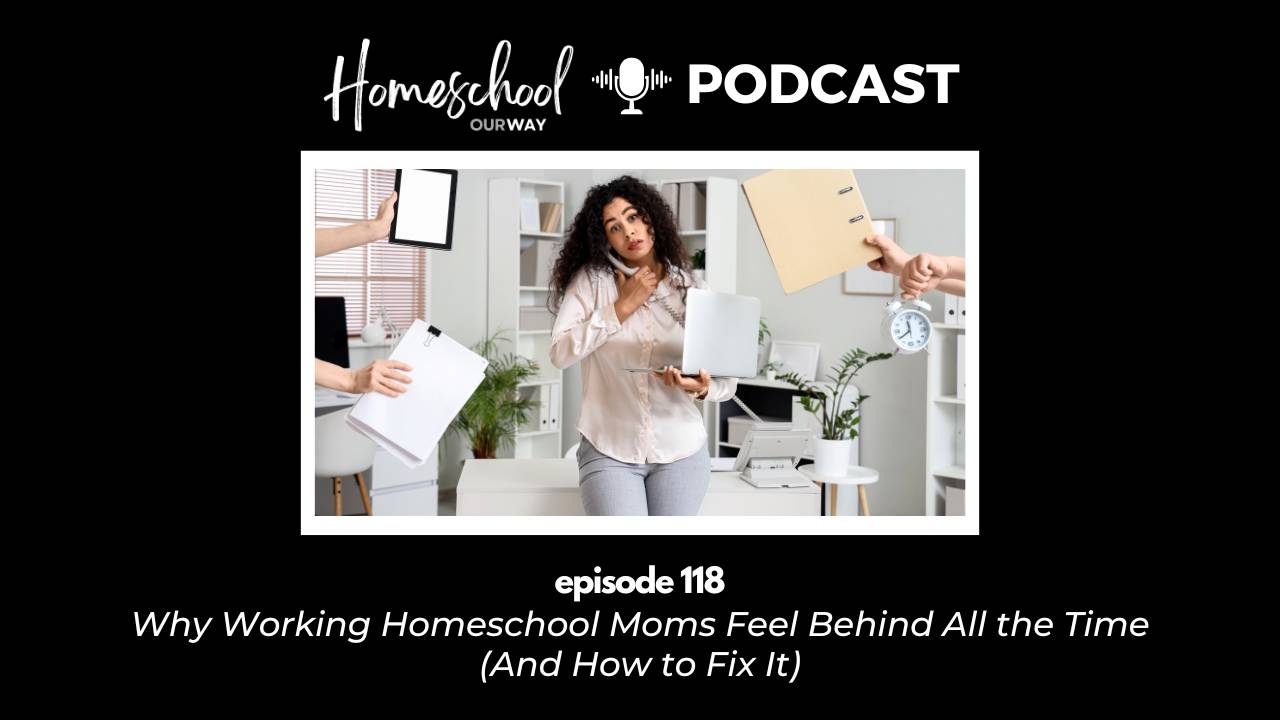
118: Why Working Homeschool Moms Feel Behind All the Time (And How to Fix It)
written by: Elan Page
🎧 Listen or Read
Prefer to read? Keep scrolling for the full article.
Want to listen? ⬇️Play the podcast episode below.
Women are great multitaskers. And if you’re reading this, you probably already know that about yourself. 😉
Think about it: we can be on a Zoom call, ordering groceries on our phone so we can make dinner tonight, and still have one eye on the kids making sure they're okay…all at the same time.
In fact, for a lot of us, the idea of focusing on just one thing at a time probably feels almost foreign. So naturally, we bring that same multitasking energy into our homeschool.
We sign the kids up for five activities that all fall on the same day. We're cramming in math and science lessons in the car as we speed from one thing to the next. We're taking calls from the parking lot while the kids are at STEM club, or answering emails on a field trip that was supposed to be family time.
And let’s be honest: that kind of multitasking is exhausting, because whenever you're doing one thing, you're mentally already onto the next thing.
And then you wind up always feeling a step behind on all fronts.
But here's what I want you to know: that feeling isn’t because you're not doing enough. It's because your homeschool approach hasn't been designed for the reality of your family’s life.
And that is fixable. So let's talk through it.
1) You're Measuring Yourself Against an Unrealistic Standard
Even though we know that every family's setup is different, a lot of us are still subconsciously measuring ourselves against homeschool moms who are living a completely different reality.
Yes, there are moms who are able to pour the majority of their time and energy directly into their homeschool efforts. But if that's not your situation, trying to measure your output against someone whose circumstances look nothing like yours will leave you feeling like you're falling short every single time.
And then there are those of us who may not compare ourselves to others…but we’re definitely hard on ourselves.
We have this “ideal self” that we’re trying to measure up to: the version of us who somehow does it all, perfectly, without breaking a sweat. And that version has a hard time accepting that we are, in fact, human.
And either way whether we’re measuring ourselves up against someone else or against the ideal version of ourselves — we’ve got to ditch the comparison trap.
It's just going to keep you stuck.
2) You Can Do the Things, Just Not All at Once
I cannot stress this enough: when it comes to trying to maximize the time and energy we have allotted for each day, less is more.
When we try to do too much, too close together, it can wear us out pretty quickly: we feel overstimulated, nothing ever feels complete, and we're mentally exhausted before the day is even halfway over.
Instead, try to pull back and simplify what’s on your plate:
Don't overload too many of the kids’ activities on the same day. When you can, aim for no more than one or two in a single day.
For academics, consider going deeper instead of wider: spend focused, quality time on a subject two or three times a week rather than rushing through it every single day.
And if your homeschool is directly clashing with your work responsibilities, there are smart ways to offset that load.
- Virtual classes can take some of the teaching off your plate.
- Hybrid microschools let you drop the kids off two or three days a week so they're learning in a quality environment while you have uninterrupted work time.
- You could also have a trusted person come into your home for a few hours — a nanny, a family member, or even a swap with another homeschool mom where your kids spend the day at her house and you return the favor another day.
Options exist, and giving yourself permission to use them is not a cop-out. It's a strategy.
3) Operate Intentionally, Not Reactively
Here's the truth: as a working homeschool mom, you can’t figure out each day as you go. You're juggling too much for that.
When you don't have a plan, you're constantly making adjustments on the fly, whether they're the right ones or not. Every week starts from scratch, which is mentally draining. And just like we talked about, you'll always feel a step behind.
Your homeschool needs structure: not so rigid that it stifles your family, but not so loose that it creates unnecessary chaos either.
What you're looking for is a flexible framework that gives each day a clear purpose, and gives your week something solid to return to when life inevitably happens. Because it will. And when it does, you want a reset plan, not a full restart.
Operating with intention is what takes you from reactive chaos to a homeschool week that actually feels manageable.
You Don't Have to Keep Running Like This
The feeling of being behind isn't some fatal flaw in you, but it is a signal that your current homeschool structure doesn't match your actual life…yet.
So once you ditch the comparison trap, give yourself permission to do less, and build a week that runs on intention instead of reaction - then everything starts to feel different.
The weeks get clearer. The guilt starts to lift. And you stop feeling like you're chasing your own life and start feeling like you're actually living it.
💡 Ready to Build a Homeschool Schedule That Actually Works for Your Real Life?
Homeschool Rhythm is a system designed to help you do exactly that. This easy-to-follow mini course will guide you through creating a homeschool week where every single day has a clear purpose, without forcing a rigid structure onto your family that doesn't fit your real life.
You'll finish with a clear weekly plan, breathing room built in, and a reset strategy for when things go sideways.
Learn more: homeschoolourway.com/rhythm
