
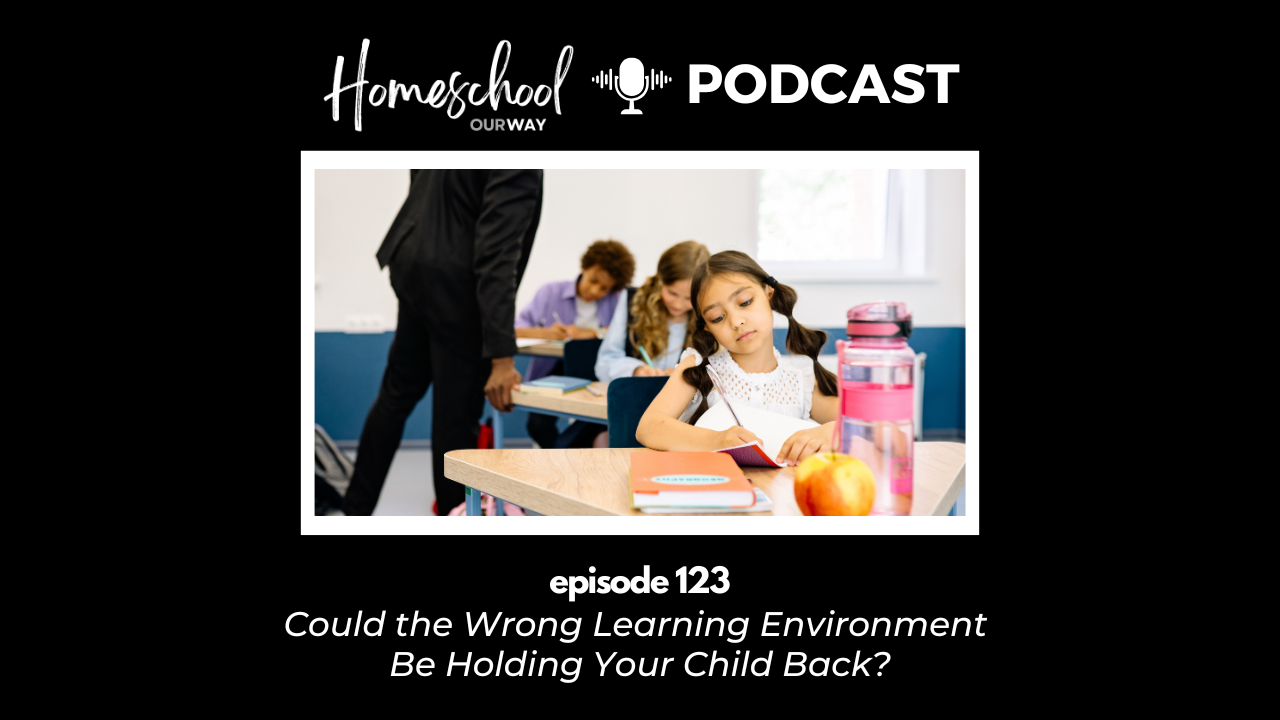
123: Could the Wrong Learning Environment Be Holding Your Child Back?
written by: Elan Page
🎧 Listen or Read
Prefer to read? Keep scrolling for the full article.
Want to listen? ⬇️Play the podcast episode below.
When a child is struggling, our first instinct is almost always to focus on the child.
They need to “try harder”. They need more support. Maybe they need a tutor or better organizational skills or more focused attention.
And sometimes, yes, those things are true.
But what if, this whole time, we've been asking the wrong question entirely?
What if the issue isn't effort or ability? Instead, it may be that the learning environment just isn't the right fit for that child?
That's what I want to explore: what kind of learning environment will actually help my child thrive?
Every Learning Environment Has Strengths and Tradeoffs
The first thing we need to let go of is this idea that there's only one universally "best" educational model out there. There isn't. Every type of educational environment has genuine strengths, and every option has tradeoffs.
- Traditional schools - whether public or private - can offer structure, predictability, built-in social interaction, and a wide range of extracurricular opportunities. For a lot of kids, that consistency is exactly what they need.
- Microschools offer smaller, more intimate settings with more personalized attention and the added benefit of community and classroom experience.
- Virtual schools offer flexibility and location independence, a real game changer for families with non-traditional schedules.
- Homeschooling gives families an incredible amount of customization. You can adjust pace, curriculum, teaching style, schedule, and learning experiences to fit your child’s needs.
None of these educational models is inherently better than the others. But they are different, and they serve different types of learners.
So the question for your family isn't necessarily "which one is best?" It's "which one is the best fit for our child?"
Different Children Thrive in Different Learning Environments
When it comes to adults, we accept this truth without question.
Some adults are completely in their element working from home, while others would lose their minds without the energy and structure of an office.
Some of us need a detailed schedule to function, while others do their best work with wide-open flexibility.
And some of us thrive in collaboration, while others need quiet and independence to think clearly.
In these instances, we chalk it up to it preferring different “work styles”. Or we identify as introverted or extroverted, and we understand that’s why we gravitate to different types of environments.
But for some reason, when it comes to kids and education, we default to the assumption that every child should be able to thrive in the exact same environment. And if a child is not thriving, we assume something must be “wrong” with that child.
But that assumption deserves to be challenged.
- Consider a child who loves movement and hands-on learning: they're going to struggle sitting at a desk for long stretches of time. That's not a discipline problem. It's a mismatch between what that child needs and what their environment is asking of them. So a flexible learning environment like a microschool or virtual school might be a good fit.
- Or think about a child who needs a lot of external accountability. They might actually thrive with the structure and routine that traditional school provides.
- And a child who gets overwhelmed in large group settings might do so much better in a smaller environment where they don't have to fight for attention or navigate constant social noise. For that child, a microschool or homeschool might make all the difference.
When a child's needs actually line up with their environment, it's a completely different experience than when they're in one that feels like a daily uphill battle.
Kids who were labeled distracted become focused. Kids who were considered behind become genuinely excited about learning. And kids who used to dread school become curious again.
Not because they changed. Because their environment did.
Look for Signs of Fit, Not Just Performance
So how do you actually know if a learning environment is working for your child?
It starts with paying attention to the right things. Because grades and test scores will only tell you part of the story.
Pay attention to how your child is experiencing learning:
- Do they seem engaged?
- Do they ask questions and show curiosity?
- Do they feel confident in their abilities?
- Do they resist going to school or seem consistently drained by it?
- Is there a subject they can't seem to connect with?
- Can you tell when they've stopped trying, or quietly lost confidence?
Slowing down to really observe these things can help you understand whether your child's current environment might be a mismatch.
That said, it's worth being honest here: no learning environment is going to feel magical every single day. Every child will face subjects they don't love, days where they're frustrated, and moments where learning is just hard. That's normal.
But when you step back and look at the overall picture, can you honestly say that your child's current environment brings out the best in them? That's the real question.
Because thriving is different from compliance. A child can follow all the rules, turn in every assignment, earn solid grades, and still be quietly losing their love of learning.
The goal isn't just for our kids to perform. It's for them to grow, to feel capable, and to remain curious while they do it.
When the environment is the right fit, those goals become so much more realistic.
Finding the Right Educational Fit for Your Child
Not every child thrives in every learning environment. And that's perfectly normal. It doesn't mean something is wrong with your child.
It might just mean they'd have a better experience somewhere else.
The goal isn’t to find the objectively “best” educational model. It's to find the right learning environment where your child can genuinely thrive.
And that's a question worth taking seriously because the answer can change everything.
Ready to Explore What Homeschooling Could Look Like for Your Family?
If you're realizing your child might need something different and you're not sure where to start, my free START Homeschooling Workshop was made for exactly this moment. I'll walk you through how to think differently about education, explore your options, and start building a learning experience that actually fits your child and your family.
