
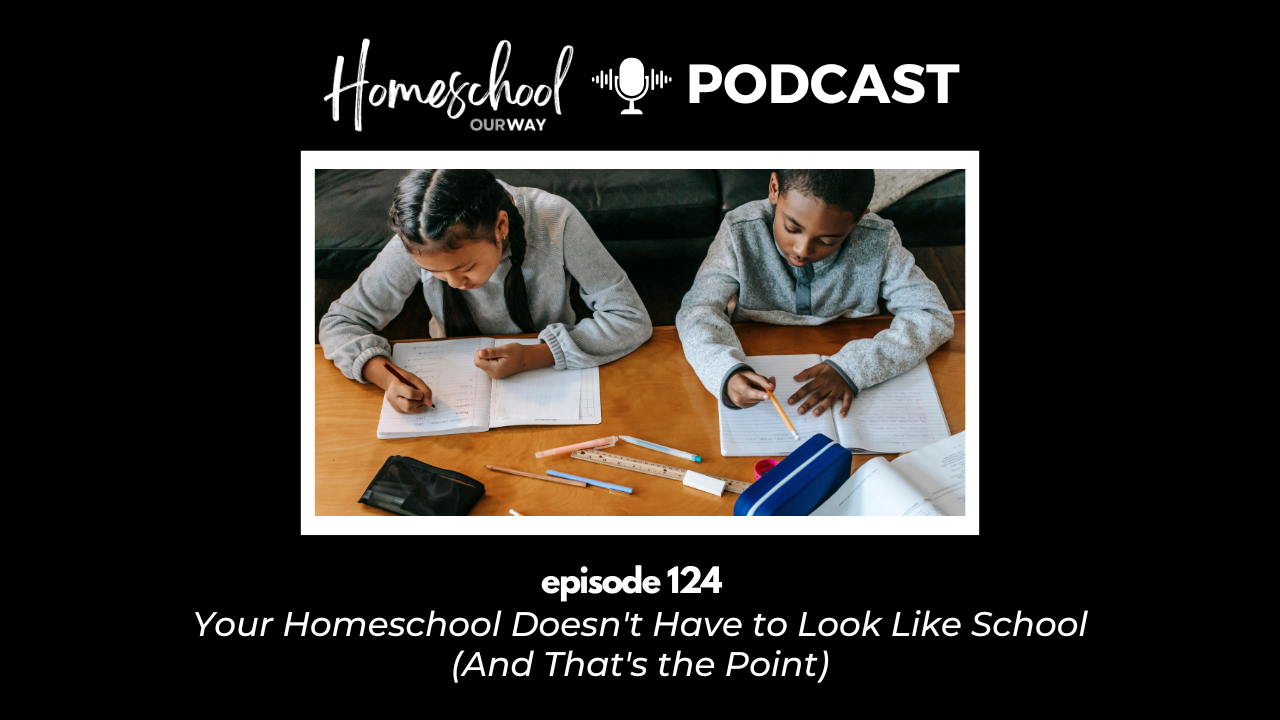
124: Your Homeschool Doesn't Have to Look Like School (And That's the Point)
written by: Elan Page
🎧 Listen or Read
Prefer to read? Keep scrolling for the full article.
Want to listen? ⬇️Play the podcast episode below.
If you're new to homeschooling - or even just thinking about it - one of the first things your brain does is try to picture what it's supposed to look like.
And if your mind imagines desks, textbooks, a schedule on the wall, and a day that runs from morning to afternoon like clockwork…there’s a good reason for that.
For most of us, the traditional classroom is the only model of education we’ve ever experienced up close.
But here's what may surprise you: some of the most thriving homeschools out there don't look anything like that. And that's not by accident. In fact, it’s a very intentional choice.
The families who build those homeschools have learned something that takes many of us a little while to absorb: you don't have to recreate “school” at home. Homeschooling gives you the freedom to create a personalized educational environment for your family.
So if you've been wondering whether your homeschool is "doing it right" because it looks different from what you expected, these are three foundational shifts that will completely change the way you think about building your family's learning experience.
1) Start With the Outcome, Not the Tools
Many new homeschool families have many of the same concerns when they’re first beginning their homeschool journey: What curriculum should I use? What does our daily schedule need to look like? How do I teach two kids at different grade levels at the same time?
While those aren’t bad questions, they shouldn't be the first ones you're asking.
When you jump straight to tools and logistics before you've defined what you're actually building, you end up designing a homeschool based on someone else's vision. And it ends up being some generic idea of what school is "supposed to" look like, instead of your own.
So the better first question is this: what kind of learning experience do I actually want for my child?
Start there and let yourself brainstorm. Here are a few things worth considering:
- Do you want more flexibility for your child to pursue the things that genuinely excite them?
- Are you hoping to build a strong academic foundation alongside real-world, hands-on learning experiences?
- Are deeper family connection and time together part of what drew you to homeschooling in the first place?
- Are you raising a child who needs a specific type of support - educational, therapeutic, or developmental - that a traditional school setting hasn't been able to provide?
A family whose vision is centered on creativity, exploration, and flexibility is going to build something that looks completely different from a family that is laser-focused on academic acceleration and college prep.
And neither of those is “wrong”. They're just different visions producing different, equally strong homeschool experiences.
The key is that your plan should be built with intention. And once you’re clear on what you want the outcome to be, everything else - the curriculum, the schedule, the structure - will emerge a lot more naturally.
2) Learning Doesn't Have to Happen the Same Way for Every Child
Your children are not the same type of learner - even if they're close in age and even if they have similar personalities.
One of your kids might absorb everything through reading. Give them a good book and they’re completely in their element. Another one of your kids might retain almost nothing from reading alone, but give them a hands-on project, and the concept clicks every single time.
Every learner is different, but that's not a “problem” to manage. That's information to design around.
One of the most powerful things homeschooling gives you is the ability to create an educational experience that fits who your child is as an individual learner.
You're not locked into one method, one pace, or one format. You can adjust how material is presented, how much time you spend on a concept, and what "showing mastery" looks like based on your specific child, not a classroom average.
This is especially meaningful for kids who have been labeled as struggling, behind, or difficult in traditional school settings. Sometimes the issue was never the child. It was the mismatch between how they learn and how they were being taught.
Homeschooling gives you the freedom to fix that mismatch. And that changes everything.
3) Learning Doesn't Only Happen Through Textbooks
Many of us have been conditioned to equate learning with formal instruction: a textbook, a worksheet, a classroom, a test.
If it doesn't look like that, we're not sure it "counts."
But learning never stops. And some of the most important, most lasting things our children will ever learn will never show up on a worksheet.
Think about what's actually happening when your child participates in a community theater production: she’s learning how to memorize, how to perform under pressure, and she’s developing collaboration skills and learning what it means to show up consistently for a group.
That's absolutely real learning. And it's the kind of learning that will likely stay with her far longer than a test she took on one day.
The same for what volunteering teaches our kids: they learn empathy and develop a sense of civic responsibility. And starting a small business works the same way: they’ll get to do real-world math and problem solving that comes to life in a way no textbook exercise can fully replicate.
Field trips, co-ops, book clubs, travel, internships, apprenticeships: these are not just rewards for finishing the "real" schoolwork. They are part of the educational plan, and they deserve to be treated that way.
So when you design your homeschool, resist the urge to treat experiences as supplemental. Because they're often where some of the deepest learning actually happens.
Your Homeschool Gets to Be Yours
There is no single “right” way for a homeschool to look.
One family might thrive with lots of community and connection: co-ops, in-person classes, group activities. Another family might build their entire educational plan around travel and exploration. And a third may opt for a more structured approach with independent learners, a predictable routine, and a consistent schedule that gives their kids a sense of clarity and direction.
All of those approaches can work, and they can all be effective because they were built around what that specific family needs.
That's the point of homeschooling - not to try to replicate traditional school at home - but to design an education that reflects your family's values, your children's needs, and the life you're actually living.
You have so much more freedom than you might realize to build something that genuinely fits. Give yourself permission to use it.
Ready to Build a Homeschool That Fits Your Family?
If you're in the early stages of homeschooling, my free START Homeschooling Workshop was made for exactly where you are. It walks you through how to get clear on your homeschool vision, choose curriculum with intention, and build a plan that actually works for your family.
