
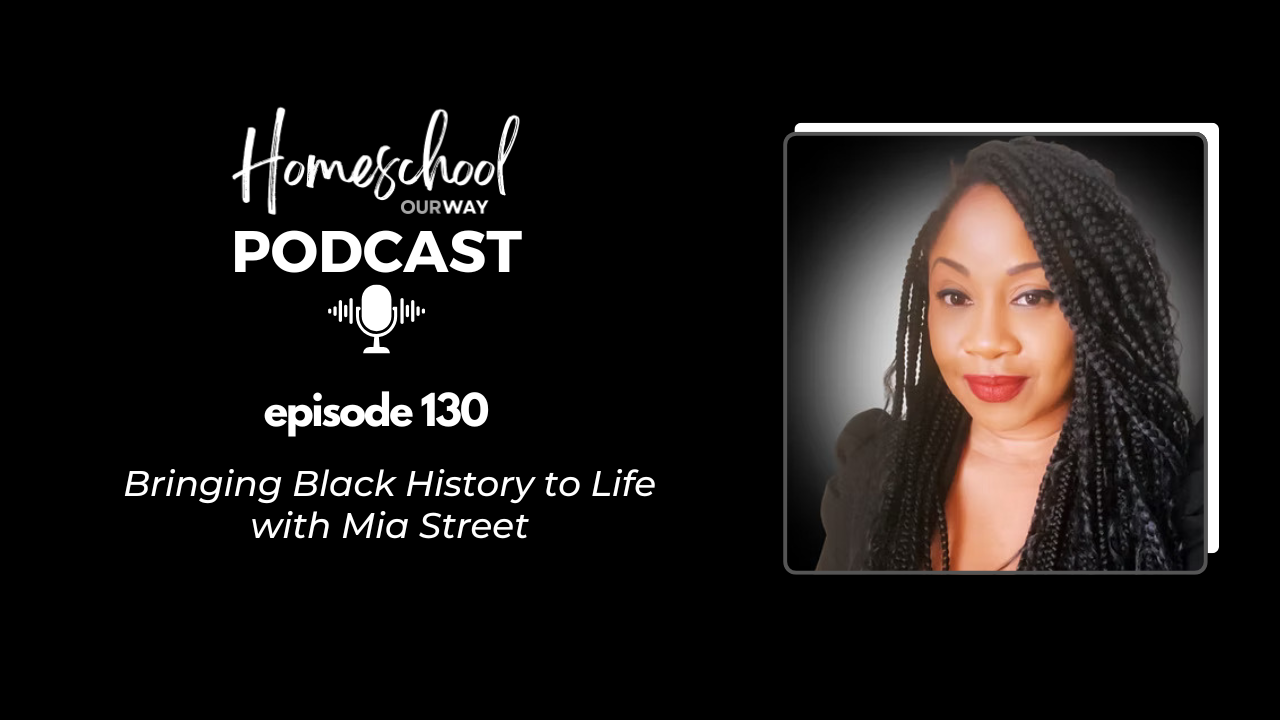
130: Bringing Black History to Life, with Mia Street
written by: Elan Page
🎧 Listen or Read
Prefer to read? Keep scrolling for the full article.
Want to listen? ⬇️Play the podcast episode below.
Teaching Black history at home isn’t simply an opportunity to make sure our kids know the important names, dates, and events of history.
For our kids to truly immerse themselves in the richness of Black history and culture, they need opportunities to see themselves within the larger story - not just in the familiar names and events that tend to make it into traditional history lessons - but across the full African diaspora.
And one of the benefits we have as homeschool families is the freedom to make that kind of learning a meaningful part of our children's education all year long.
I sat down with Mia Street, Executive Director of the Black History 365 Education Foundation, to talk about how families can create learning experiences around Black history that allow our kids to connect with it, experience it, and make it their own.
Learning Is Meant to Be Experienced
When we think about teaching Black history, our minds often gravitate to books and curriculum alone.
And yes, having strong, culturally affirming curriculum absolutely matters…but Mia challenges us to think beyond simply giving our kids the information.
She tells us, instead, to allow them to experience it.
Her philosophy comes from something her grandfather, Moses Osborne - an educator and a former student of George Washington Carver at Tuskegee - used to say:
You haven't taught unless your students have learned.
Simply covering the material isn't the same thing as a child actually understanding and connecting with it, which is why Mia encourages kids to do something with what they're learning.
That philosophy is at the heart of Black History 365's BasquiArt Camp, an immersive summer experience in Dallas, Texas, that combines Black history, art, and experiential learning. Throughout the week, students interact with history in a variety of ways:
- Field trips: Students visited the Dallas Holocaust and Human Rights Museum and took a Hidden Dallas Black history tour, connecting what they were learning to real people, places, and events.
- Food: Students experienced foods from across the African diaspora, using food as another entry point into the cultures and traditions they were studying.
- Art: Students explored Black history through art and then created their own work from what they learned.
- Music, dance, and photography: Students encountered Black history through the creative forms Black people have used to document and express our experiences across generations.
Mia and the Black History 365 team have also created a BasquiART Workbook that families can use to bring some of that same approach to learning at home.
The point isn't simply to make history more "fun." It's to give kids more ways to engage with what they're learning so they can connect with it, understand it, and remember it.
Ways to Bring Black History to Life at Home
You don't necessarily have to recreate a weeklong camp to bring Black history to life at home. One of the easiest places to begin is by tapping into things that your child already enjoys.
Have a kid who loves to cook? Explore the history of foods across the African diaspora. Mia recommends High on the Hog: How African American Cuisine Transformed America, a Netflix documentary that traces the history and influence of Black American cooking. It’s a great opportunity to watch together, and then bring the experience into your own kitchen by cooking a dish or exploring an ingredient featured in the series.
Have an art lover? Study Black artists and give your child opportunities to create their own artwork.
For kids who love science and technology, organizations like Siyanse, Dibia DREAM, and STEM NOLA offer hands-on STEM learning experiences for Black students.
And don't overlook the ways your kids already like to consume information. Black History 365 has a hip-hop album that teaches Black history through music, while Brown Hands Literacy offers additional opportunities to connect learning through literacy.
Museums and historical sites are another powerful way to make history tangible. Black History 365 has compiled a list of Black history museums across the country, and some even offer virtual museum tours that open up even more possibilities if traveling to each one may not be feasible.
And don’t overwhelm yourself by trying to incorporate all of these methods. Remember that the goal is to find experiences that help your child connect with what they're learning in ways that are meaningful to them.
The method can change depending on the child. But the learning doesn't have to.
Teach the Full Story of the African Diaspora
Another important part of bringing Black history to life is helping our children understand just how expansive that history really is.
Black History 365 takes a global approach, giving our kids opportunities to learn about Black cultures, accomplishments, innovation, resistance, creativity, and community throughout the world.
You can take a look at their collection of K-12 textbooks covering U.S. history, African history and Latin American history…and keep your eye out for their Caribbean history book coming in 2027.
Learning about Black history and culture throughout the diaspora gives our kids a fuller understanding of the breadth and diversity of our collective story.
The Freedom to Bring Black History to Life
As homeschool families, we have the freedom to think beyond simply what we want our kids to learn about Black history and consider how we want them to experience it.
Black History 365 is continuing to create new opportunities for kids to learn in this way with the development of Moment Makers, a new 2027 program that will operate at the intersection of STEAM learning, creativity, career exploration, and HBCUs. The ultimate goal will be to help youth explore STEAM career pathways and the role HBCUs can play in preparing them for those fields.
As Mia shared during our conversation, HBCUs provide powerful examples of Black brilliance, innovation, and achievement. Whether or not our children ultimately attend one, they're an important part of our history and an important part of the possibilities our kids should know exist.
Because ultimately, teaching Black history isn't just about giving our kids information to remember. It's about helping them connect with the history and culture they're learning in ways they can see, hear, taste, experience, and make their own.
And if you're looking for resources to help you do that, you can learn more about Black History 365 and the work Mia Street is doing through the Foundation by exploring the links below.
Black History 365 Education:
Website | Instagram | Facebook
Black History 365 Education Foundation:
Website | Instagram | Facebook | LinkedIn
THE HOMESCHOOL CURRICULUM GUIDE FOR FAMILIES OF COLOR
Looking for curriculum that reflects your child's history, culture, and identity? My Homeschool Curriculum Guide for Families of Color takes some of the guesswork out of the search by bringing together culturally affirming curriculum options across subjects and grade levels!
*You can also grab the Curriculum Guide as part of my Homeschool Kickstart Bundle, along with the Homeschool Rhythm mini-course to help you create a flexible schedule that works for your family.
