
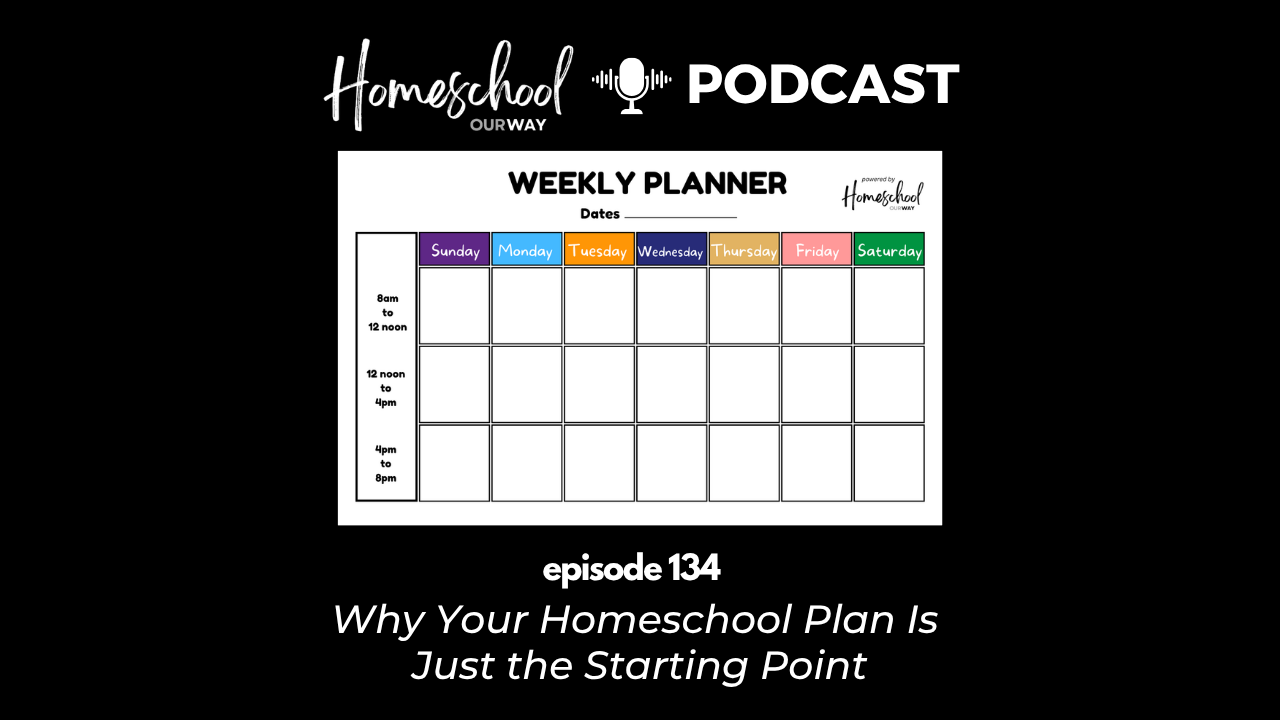
134: Why Your Homeschool Plan Is Just the Starting Point
written by: Elan Page
🎧 Listen or Read
Prefer to read? Keep scrolling for the full article.
Want to listen? ⬇️Play the podcast episode below.
If your homeschool year started with a beautifully mapped-out plan…and then those first few weeks looked a little different as they played out in real life, don’t worry. You are not doing anything wrong.
Your plan has not necessarily “failed”. It’s likely just time for a few strategic, intentional adjustments.
And that’s because your homeschool plan was never meant to be the finish line. It's just the starting point.
And once you understand how to evaluate it and tweak it along the way, you can build a rhythm for your family that actually holds up in real life.
Here are four key ways to approach it.
1) "Busy" Isn't the Same Thing as Accomplished
This is one of the sneakiest traps in homeschooling, especially when your kids are involved in a lot of activities.
You can have a completely full week - co-op, sports, classes, errands, etc - and still get to Friday feeling like nothing academic actually happened. The week was busy. It just wasn't necessarily accomplishing what you needed it to.
This is incredibly common with families who have kids heavily involved in sports, activities, and other extracurriculars. The instinct is usually to try to cram more school into an already packed schedule. But more school work isn't always the answer. Sometimes the real fix is reorganizing how school fits into the week you're already living.
That might look like:
- Building a simple, independent morning work block instead of a long list of subjects every day
- Asking whether every activity truly needs to happen during the school year, or if some could move to summer
- Adding intentional downtime into the week instead of packing every single day
Those changes don't create more hours in the day. But they absolutely change how the week feels. Suddenly there's room for academics that don't feel rushed and downtime that doesn't feel nonexistent.
2) Start With Your Real Homeschool Schedule, Not the Ideal
Here's a habit worth building into every semester: look at your actual week, not the week you wish you had.
- When are your kids genuinely alert and ready to learn?
- When are you actually available to help them?
- And where does your family need some breathing room that isn't currently there?
Those questions matter more than any schedule you build on paper.
This is exactly why the first couple of weeks of a new semester are so valuable. You can prepare carefully in advance, but you don't really know how that plan will hold up until you're living it day-to-day.
Kids get tired in ways you didn't expect. Transitions take longer than you planned. Energy dips at times you didn't account for.
So pay attention: not to judge whether you planned well, but to gather information. That information is what helps you build something that actually fits.
3) Give Different Days Different Purposes in Your Week
One of the biggest shifts you can make in your homeschool is realizing that every day does not have to look the same.
Some families fall into the trap of either overscheduling every day with enrichment and activities, or underscheduling to the point where days feel unanchored and directionless. Both extremes usually come from the same missing piece: nobody has stopped to ask what the family's natural energy and rhythm actually look like.
When does your child focus best? When do you have the most capacity to teach? What does your family naturally gravitate toward in the mornings versus the afternoons?
These are simple questions, but for a lot of homeschool moms, they've genuinely never been asked before.
Once you start building your week around the answers, you can design days with real purpose instead of trying to make every day identical. For example:
- A heavier academic day when energy is high and outside commitments are low
- A lighter, slower day in the middle of the week with reading, games, and rest
- A hands-on exploration or field trip day instead of another full day of book work
That's not a lack of structure. That's actually very intentional structure. Your homeschool week doesn't need seven matching days to be effective. It needs days that are aligned with how your family actually functions.
4) Build Flexibility Into Your Homeschool Schedule
Here's the part I really want you to hold onto: the schedule you built at the start of the semester is not a contract.
Your kids are going to keep changing. Your work might change. Your family's needs will shift as the season goes on. That's not a sign your original plan was wrong; it's just what happens when real life meets a plan made in advance.
This is especially true if your family has gone through a big transition, like a move to a new city or a new season of life. When everything feels new at once, the instinct is often to add more structure to try to gain control.
But more often than not, what's actually needed isn't more: it's better organization of what's already there.
Look at your real responsibilities, your real energy, and your real capacity, and give your week structure and flow instead of piling on more.
And give yourself permission to change things when they're not working:
- Move schoolwork to a different time of day
- Drop an activity, or add one back in later
- Rework the order of your day entirely
The goal was never to build a schedule that never changes; the goal is to build a rhythm flexible enough to change with your family, as many times as it needs to.
Trust What You're Learning as You Go
As you move through these next few weeks, keep asking yourself the questions that actually matter: What's working? When are your kids at their best? When are you at your best? Where do you keep playing catch-up? And where could you use just a little more breathing room?
Those answers will tell you far more about the rhythm your family needs than any calendar template ever could.
A plan that needs adjusting isn't a plan that failed; rather, it's a plan doing exactly what it's supposed to do…showing you where to grow.
You don't need a perfect schedule. You need a rhythm that works for your family. And you're already learning how to build it.
Ready to build a schedule that actually fits your family's real life?
If you're realizing that your homeschool schedule needs a little more flexibility and intention, that's exactly what Homeschool Rhythm is designed to help you create.
Homeschool Rhythm is a step-by-step mini course that walks you through creating a flexible homeschool structure around your schedule, your energy, and your priorities.
