
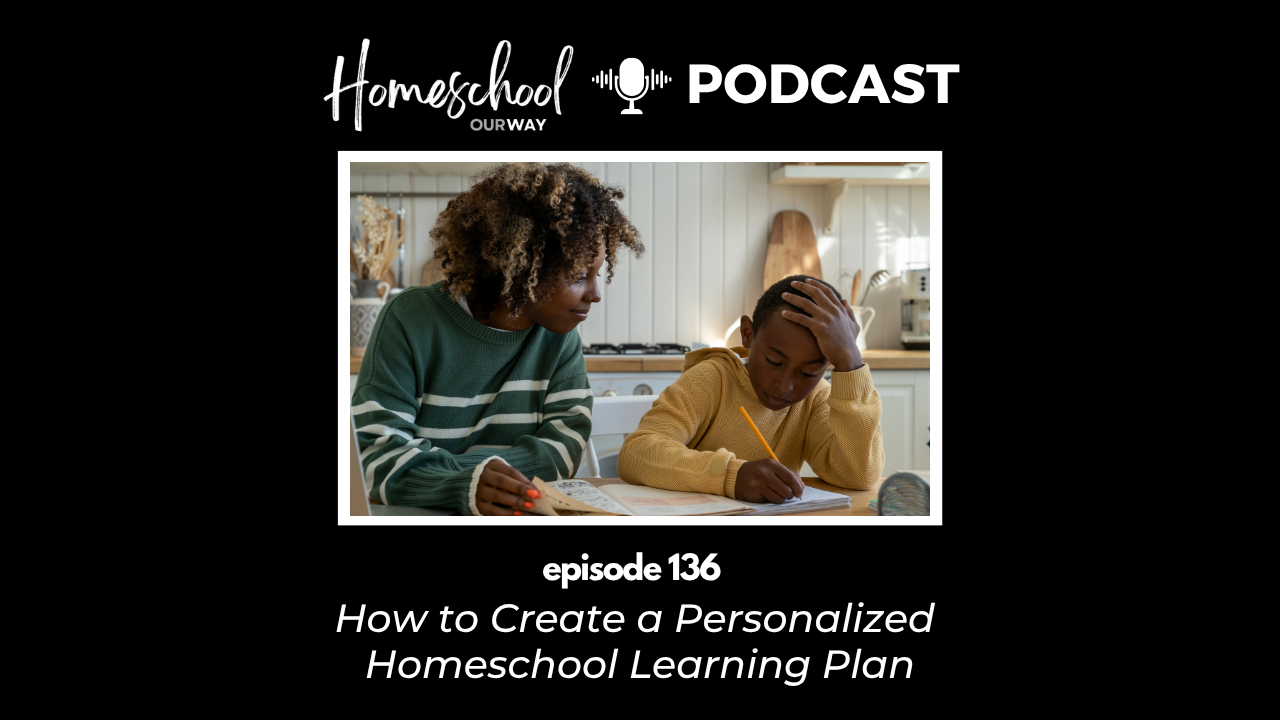
136: How to Build a Personalized Education for YOUR Child
written by: Elan Page
🎧 Listen or Read
Prefer to read? Keep scrolling for the full article.
Want to listen? ⬇️Play the podcast episode below.
One of the greatest advantages of homeschooling is the freedom to create an educational experience that works for YOUR child. You don't have to follow a one-size-fits-all approach or squeeze your child into someone else's idea of what learning should look like.
Instead, you get to consider who your child is, how they learn, what interests them, and what matters most to your family.
That's the beauty of personalized learning: it allows you to build a homeschool experience around your child's individual needs while making room for the academic goals and family priorities that matter to you.
But where do you start? How do you take all those ideas and turn them into an actual academic plan?
I'm going to walk you through three important things to consider as you create a personalized homeschool learning plan…one that supports your child's growth, nurtures their curiosity, and reflects your family's vision for education.
1) Understand Your Child's Learning Preferences
One of the first things I encourage homeschool parents to do is pay attention to how your children engage with information. Every child is different, and understanding their learning preferences can help you choose resources and activities that make lessons more effective and enjoyable.
There are four common learning styles to consider:
- Visual learners enjoy diagrams, charts, infographics, and videos…anything that allows them to see concepts in action.
- Auditory learners thrive when they can hear information. Audiobooks, discussions, lectures, and podcasts may be especially engaging for them.
- Kinesthetic learners love movement and hands-on experiences. Experiments, building projects, games, and other interactive activities can help bring lessons to life.
- Reading/writing learners connect with words, whether through books, written instructions, note-taking, or journaling.
Of course, children don't always fit neatly into just one category. Your child might enjoy watching a video to learn about history but prefer hands-on activities when studying science. The goal isn't to put them in a box. It's to understand the different ways they engage with learning so you can offer experiences that keep them interested and involved.
Here's an example: If you sit your child down with a math workbook, it's like pulling teeth. But if you turn that same math lesson into a game or a building project, they're all in! In this case, they may really enjoy hands-on, kinesthetic learning experiences.
Or maybe you try explaining a history lesson through conversation, and your child completely zones out. But show them a colorful infographic or an engaging video, and suddenly they're asking questions and making connections! That's a clue that visual resources may be especially helpful.
Not sure how your child learns best? I've got you!
One of the moms I coached through my program, the Homeschool Launch Blueprint, originally thought her daughter was a visual learner. But after taking my Learning Style Quiz, she discovered that her daughter actually leaned more toward kinesthetic learning!
That insight helped her think differently about the resources and activities she was choosing for her daughter. And once you have a better understanding of how your child engages with information, you can start choosing resources and activities that work for them. And don’t be surprised if this starts to make learning a lot more enjoyable for both of you!
If you even want to take this a step further, in episode 9 of the Homeschool Our Way Podcast, I dive deeper into how to use your child's learning style to support their education, including the types of activities, resources, and even career paths that may align with their natural preferences.
2) Understand Your Academic Requirements and Family Priorities
Before you start researching curriculum or choosing resources, take some time to understand your state's homeschooling requirements. Every state has its own guidelines, and you'll want to know what's expected of you as a homeschooling parent.
Some states have specific subjects that must be taught, while others offer considerably more flexibility. You can find information about your state's requirements through Homeschool Laws by State, which allows you to select your state and review the applicable guidelines.
Once you understand the legal requirements, you can also explore your state's academic standards. These standards outline what students are generally expected to know at different grade levels and can serve as a helpful reference when planning your child's education. Your state's Department of Education website is a good place to find this information.
For example, here in Texas, I have quite a bit of flexibility in how I approach my daughters' education. I like to use the state academic standards as a guide to help me stay on track with core academic subjects, but I also make room for things that are important to our family, like Black history and financial literacy.
And that's something I want you to think about, too: What matters most to YOUR family?
Maybe you want to place a greater emphasis on STEM, creative arts, entrepreneurship, or faith-based learning. Perhaps you want to make sure your children have meaningful opportunities to explore their cultural heritage and learn about people and experiences that aren't always represented in traditional textbooks.
Whatever your priorities may be, this is your opportunity to make your homeschool reflect your family's values and vision for education.
3) Incorporate Your Child's Interests and Passions
Now here’s the fun part: you get to figure out what lights up your child, and then lean in!
Do they love art? Are they fascinated by science experiments? Maybe they're obsessed with dinosaurs, sports, music, or coding.
Whatever captures their attention, think about how you can incorporate those interests into their learning plan.
For example, if your child loves dinosaurs, you could use that interest as a starting point for reading, science, history, and even art projects. They could read books about prehistoric creatures, explore fossils and the history of dinosaurs, or create their own dinosaur-inspired artwork.
The possibilities are endless!
And here's why this matters: when children have opportunities to explore subjects they're genuinely interested in, learning becomes more engaging.
It also helps them see that education isn't just something that happens during school hours. It's something they can pursue anytime through their own curiosity and interests.
And don't forget about extracurricular activities! Sports teams, dance classes, music lessons, and robotics clubs all provide valuable learning experiences too.
In our homeschool, we make sure to leave room for extracurricular activities because I believe they're an important part of a well-rounded education. These experiences give children opportunities to develop new skills, explore their interests, build relationships, and discover talents they might not have known they had.
Remember, your homeschool learning plan doesn't have to be limited to traditional academic subjects. There's room for exploration, creativity, and all the things that make your child who they are.
Putting Your Personalized Homeschool Learning Plan Together
Now that you've thought about your child's learning preferences, your family's academic priorities, and the interests that make your child light up, it's time to bring everything together!
I recommend setting aside a couple of hours to brainstorm, research, and start mapping out some ideas. I like to do this at the beginning of each school year for my own family, but you can absolutely do it at any time. Sometimes I'll sneak away to the library or a nice coffee shop so I can lock in, get focused, and really think through what I want our homeschool year to look like.
As you start researching, here are a few things to keep in mind:
- Explore your curriculum options. Look online and in homeschool groups, particularly Facebook groups, for reviews and recommendations from other homeschool parents. You can learn a lot from families who have actually used the resources you're considering.
- Keep track of your ideas. Create a simple spreadsheet or checklist to organize the subjects, books, curriculum options, and activities that interest you. Make note of where you found each resource, how much it costs, and any reviews or feedback you've come across.
- Think about how everything fits together. Consider how your curriculum choices, extracurricular activities, and other learning experiences support the goals you've identified for your child and family.
You don't have to figure everything out at once, and you certainly don't need a complicated planning system. Start with what you know, gather ideas, and build from there.
And remember, this is a starting point, not a plan you have to follow perfectly. One of the greatest advantages of homeschooling is the ability to adjust as your child grows, their interests change, and you discover what works best for your family.
Your Homeschool, Your Way!
The beauty of homeschooling is that you get to create an educational experience that reflects the child in front of you and the vision you have for your family. It doesn't have to look like anyone else's homeschool, and it certainly doesn't have to be perfect.
So here's my challenge to you: this week, take the first step and learn more about how your child learns: take my free Homeschool Our Way Learning Style Quiz, jot down what you notice, and start thinking about how you can use those insights to make learning more engaging.
And if you're ready for a step-by-step guide to building a homeschool experience that truly fits your family, check out my Homeschool Launch Blueprint Collective. It's designed to help you create your homeschool vision, choose the right resources, establish a family rhythm, and build a plan with confidence and clarity.
Remember, you don't have to recreate someone else's homeschool. You have the freedom to create one that works for YOUR family.
Because this is your homeschool…do it YOUR way!
